 Elgoline


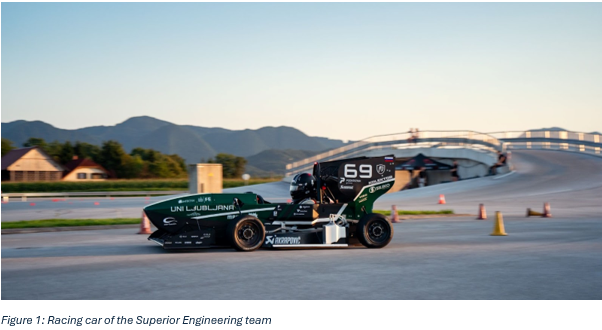
Formula Student is an international engineering competition in which teams of students from various faculties participate with one common goal and vision: to create an innovative and technically advanced racing car that is competitive and stands out in both static and dynamic disciplines.
The project consists of several key subsystems that together ensure reliable and safe operation of the racing car. After many sleepless nights and long weekends, future engineers can proudly send it onto the race track. One of the key components is the battery pack, which provides energy for the operation of the electric racing car.
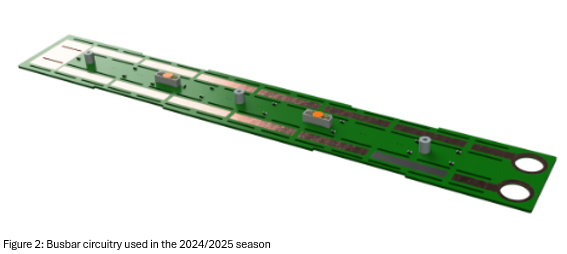
This year as well, Elgoline is collaborating with the Superior Engineering student team of the University of Ljubljana, where for the second consecutive year we are jointly designing an optimal solution for a dedicated BUSBAR circuit, implemented in combination with a BMS Slave circuit and used to interconnect pouch-type LiPo cells within the battery.
We will redesign the busbar circuit as a 2 mm thick multilayer printed circuit board, into which 2.0 mm thick copper plates are precisely embedded, intended for cell connectivity and high current transmission (up to 200A). This design offers us an elegant solution for fixed and more robust connections between cells, while also ensuring electrical contact directly between the copper plates and the signal layers of the circuit. This allows the electrical signals from the voltage and temperature sensors on individual cells to be transmitted to the so-called board-to-board connectors without additional wires and, through these, to the BMS Slave, enabling reliable operation, easy system management, and package safety.
This unique approach also contributes to achieving one of the team’s main goals this season – reducing the overall weight of the race car. The busbar circuit enables shorter and thinner connections between cells, which leads to less copper being used and, consequently, a lower total weight. By enabling direct laser welding of cells to inserted copper plates, it also eliminates the need for cell screwing, further contributing to lower vehicle weight. Furthermore, due to higher current capacity and more even current distribution, it guarantees lower heat loss and ensures an even higher level of vehicle safety.
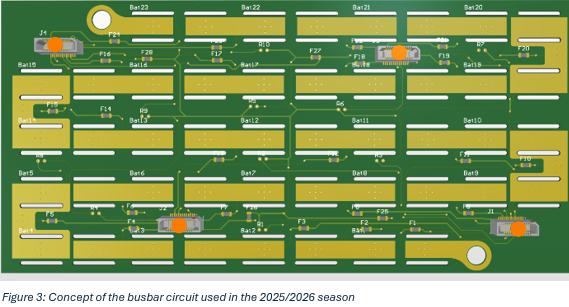
Since the team decided to choose a new cell this year, this will lead to a different cell configuration in the segment and, consequently, the need to develop a more complex busbar circuit. That is why, this season, we will combine Elgoline’s in-depth technical knowledge in the field of printed circuit board manufacturing with the ambitious goals of a team of motivated students to create an u unique busbar circuit that will safely and reliably supply the race car with electrical power.

